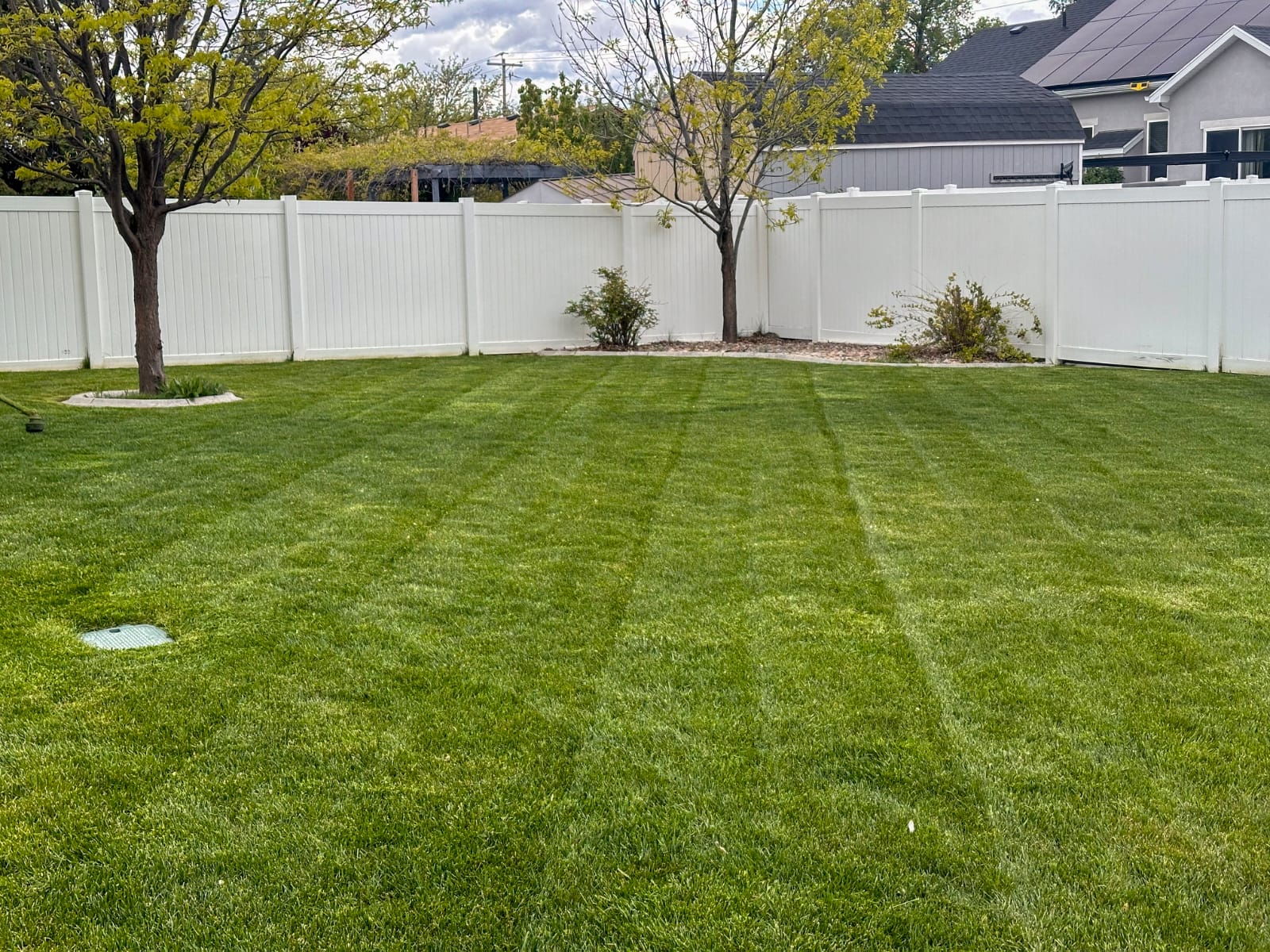
August is one of the most demanding months of the year for lawns across Utah County. Cool-season turfgrasses — Kentucky bluegrass in particular, which dominates most residential properties in Saratoga Springs, Lehi, Eagle Mountain, and surrounding communities — are well past their spring peak and carrying weeks of accumulated heat stress. High evapotranspiration demand, inconsistent irrigation, and heavy foot traffic from summer activity all take a toll.
In this environment, every management decision carries weight. And one of the most impactful — and most commonly mismanaged — is mowing height. A simple adjustment to how high you set your deck in August can either protect your lawn through the toughest weeks of the year or amplify existing stress into lasting damage that takes the entire fall to recover from.
Why Shorter Is Not Better — And Never Was
The idea that cutting grass shorter reduces how often you have to mow is intuitive but incorrect. Turfgrass above-ground height is directly related to root depth — taller grass consistently grows deeper roots. This relationship exists because longer leaf blades provide more surface area for photosynthesis, which powers the energy the plant uses to develop its root system. When you cut grass short, you reduce photosynthetic capacity and effectively signal the plant to maintain a proportionally smaller root system.
In August, when turf is already stressed by heat and elevated water demand, cutting it short removes one of its primary protection mechanisms against summer stress. Short-mowed grass in peak heat is more likely to scorch, thin out quickly, and decline into visible brown patches — and it recovers significantly more slowly from heat stress than taller grass maintained at the recommended height.
Many homeowners who cut low in summer report needing to water more, not less — because short grass exposes more soil surface to direct sun and radiant heat from sidewalks and driveways, dramatically accelerating evaporation. The perceived convenience of less frequent mowing is more than offset by higher water bills and declining turf quality. Our Lawn Mowing Services team maintains turf at proper heights throughout the season — it’s one of the simplest ways we protect lawn quality for our clients through summer.
Recommended Summer Mowing Height for Utah County Lawns
Kentucky bluegrass — the predominant turf variety in most Saratoga Springs, Lehi, Eagle Mountain, and Orem yards — performs best when maintained between 3 and 4 inches during summer months. Three and a half inches is a practical target for most properties: tall enough to shade the soil and root zone meaningfully, not so tall that the turf becomes prone to disease or creates a scalping risk at the next mow.
Tall fescue varieties, found in some Utah County yards — particularly in shadier or lower-traffic areas — share a similar range and should also be kept at the taller end of their spectrum during summer heat. Never drop below 3 inches on cool-season turf in July or August regardless of type.
The one-third rule is the most important mowing principle to follow regardless of grass type: never remove more than one-third of the total blade length in a single mowing session. If your grass has grown to five inches between mowings, cutting it to three inches removes 40% of the blade — too much at once. Either increase mowing frequency to stay within the one-third threshold, or bring the height back gradually over two mowings a few days apart.
The Domino Effect of Cutting Too Short in August
Consistently short mowing in August initiates a predictable chain of compounding problems that can persist through the fall recovery season. Here’s how the cascade typically unfolds:
Short grass exposes bare soil directly to the sun. Exposed soil absorbs and radiates significantly more heat than soil shaded by a three-inch turf canopy — soil temperatures under short-mowed grass can run 10–15°F higher than under properly-maintained turf. As soil temperatures rise, water evaporates more rapidly from the surface, increasing irrigation demand. Higher irrigation frequency, if applied in short cycles to compensate, keeps the soil surface consistently wet without deep penetration — encouraging shallow roots and creating fungal disease conditions.
Weakened, shallow-rooted turf becomes more vulnerable to weed invasion. Many of the most aggressive summer weeds — including crabgrass, spurge, and prostrate knotweed — germinate and establish most aggressively in thin or bare soil exposed by short mowing. This is why lawns that are consistently cut short in summer often present with substantially more weed pressure by fall — the mowing practice created the conditions that allowed weeds to gain a foothold.
Annual Aeration Services help break this cycle by reducing compaction, improving the depth of water penetration, and promoting the deeper root development that makes turf more resilient to short-mowing stress. Our Fertilization Services team can also assess whether nutrient deficiencies are compounding the stress created by improper mowing height.
Additional August Lawn Care Practices That Matter
Sharp mower blades make a meaningful difference during summer stress. Dull blades tear grass tissue rather than cutting it cleanly, leaving jagged edges that brown rapidly and create entry points for fungal disease organisms. A blade sharpened at the start of the season will typically need sharpening again by mid-summer if you’re mowing regularly. If you notice grass appearing slightly tan or off-color immediately after mowing — rather than clean and green — a dull blade is often the cause.
Avoid mowing during the hottest hours of the day. Mid-afternoon mowing on a 95°F August day adds mechanical and dehydration stress to turf that is already heat-stressed. Early morning mowing — after dew has dried but before midday heat — is gentlest on the turf. Evening is acceptable but leaves clippings on wet grass overnight, slightly increasing disease risk.
Mulching clippings back into the lawn is almost always preferable to bagging during August. Grass clippings are 80–85% water and break down quickly without contributing to thatch accumulation — a common misconception. Returned clippings provide the equivalent of one or two nitrogen fertilizer applications per season and help retain surface moisture. The only exception is when clippings are so long and clumped that they physically smother turf underneath — in that case, disperse them by making a second mowing pass over the clumps.
For end-of-season preparation, our Seasonal Cleanup Services ensure your lawn finishes summer in the best possible condition for fall recovery — including final height adjustments, thatch management, and assessment of any areas that may benefit from overseeding before temperatures cool.
FAQ
Q: What’s the ideal mowing height for Kentucky bluegrass in August?
A: For most Utah County properties, 3 to 3.5 inches is the recommended summer mowing height for Kentucky bluegrass. This height provides meaningful soil shading to reduce evaporation, supports deeper root development, and gives the turf enough leaf area to manage heat stress. Never cut below 3 inches during July or August.
Q: How often should I mow in August?
A: Mowing frequency should be governed by growth rate, not a fixed calendar schedule. Cool-season grasses like Kentucky bluegrass slow their growth significantly during peak summer heat. Most Utah lawns need mowing every 10–14 days in August rather than the weekly schedule typical of spring and fall. Use the one-third rule as your guide: when the grass reaches one-third above your target height, it’s time to mow.
Q: Should I bag my grass clippings in summer?
A: No, in most cases mulching is preferable. Grass clippings decompose quickly and return nitrogen and organic matter to the soil. The common belief that clippings cause thatch is a myth — thatch is caused by undecomposed stems and roots, not leaf clippings. Bag only when clippings are long enough to mat and smother underlying turf, and in that case, disperse rather than remove them if possible.
Q: My lawn looks fine when I mow short — why change?
A: Short-mowed lawns often look acceptable in the days immediately following a mow, but the cumulative stress from repeated short cuts compounds over a full summer. By late August, short-mowed lawns typically show significantly more brown patches, thinner turf density, more weed pressure, and slower fall recovery than lawns maintained at proper height. The damage accumulates gradually rather than appearing all at once.
Q: Is August too late to fix a struggling lawn?
A: No. Adjusting mowing height, improving irrigation efficiency, and scheduling Aeration Services for fall can all help turf recover from summer stress. Fall is actually the best window for cool-season grass recovery — as temperatures drop and fall rains arrive, Kentucky bluegrass naturally rebounds. Getting the right management practices in place in August sets your lawn up for the strongest possible fall recovery. Contact Us to discuss what your specific lawn needs.
Q: How do I sharpen my mower blade or know if it needs sharpening?
A: Inspect the blade at the start of each season and again mid-summer. Signs of a dull blade include: turf appearing brownish or slightly torn rather than cleanly cut immediately after mowing, ragged or frayed grass tips visible up close, and uneven cut height across the mowing path. Most homeowners can sharpen blades with a metal file or bench grinder, or have them professionally sharpened at a hardware or small engine shop for a nominal fee. A sharp blade is one of the least expensive and most impactful investments in summer lawn quality.
Q: Should I change my mowing height for fall compared to summer?
A: Yes. As temperatures cool in September and October, you can gradually lower your mowing height back toward 2.5 inches. The final mow of the season — typically in October for most Utah County properties — should be at around 2 to 2.5 inches. This reduces the risk of snow mold formation under matted tall grass in winter. Our Seasonal Cleanup Services include proper final mowing height adjustment as part of a complete end-of-season program.
Areas We Serve: Utah County and Salt Lake County including Saratoga Springs, Lehi, Eagle Mountain, Orem, Draper, Herriman, Riverton and South Jordan.